Buy CJC-1295 (Mod GRF 1-29): a GHRH analogue in the research spotlight
Growth hormone is released in pulses, controlled by a delicate interplay of releasing and inhibiting hormones. This system is exactly where research interest in CJC-1295 (Mod GRF 1-29) begins. The synthetic 29-amino-acid peptide belongs structurally to the growth hormone-releasing hormone family and, as the no-DAC form, is distinguished from the long-acting DAC variant.
Two molecules under one name
The name CJC-1295 refers to two different constructs. The DAC form carries an additional albumin-binding group that enables longer circulation. The no-DAC form, also known as CJC-1295 without DAC or Mod GRF 1-29, does not have this group. The 2024 FDA assessment explicitly describes it as a distinct synthetic 29-amino-acid GHRH analogue.
The distinction is not a formality. The extended circulation belongs to the DAC form and cannot be transferred to Mod GRF 1-29. The no-DAC form is therefore described as a molecule in its own right.
How GHRH acts on the pituitary
GHRH is produced in the hypothalamus and reaches the pituitary via the portal system. There it binds to the GHRH receptor on somatotropic cells of the anterior pituitary and stimulates the release of growth hormone. The receptor is a G-protein-coupled receptor and translates the GHRH signal into an intracellular cascade. Secretion is pulsatile and modulated by somatostatin and feedback signals.
Growth hormone acts directly in various tissues and stimulates the formation of IGF-1 in the liver. This axis links hormonal rhythm, receptor signals and peripheral metabolic processes. The structural similarity to GHRH makes the no-DAC form interesting for studies of this system.
What the DAC experiments actually showed
The foundational work by Jetté and colleagues from 2005 examined hGRF(1-29)-albumin bioconjugates. In cultured rat pituitary cells, these conjugates activated the GRF receptor; in rats, the authors investigated growth hormone release. The study describes CJC-1295 as a long-acting GRF analogue.
The experimental design is decisive: the study examined albumin bioconjugates, meaning DAC derivatives, not the no-DAC form. The results therefore do not demonstrate equivalent activity or prolonged exposure for Mod GRF 1-29. The DAC principle relies on binding to albumin, which prolongs circulation; the no-DAC form does not have this mechanism.
Starting points for research
GHRH biology gives rise to several areas of investigation that are relevant to the no-DAC form. Four topics stand out:
- Receptor binding and signal transduction in somatotropic cells
- Pulsatility of growth hormone secretion and its regulation
- Downstream effects on IGF-1 and growth factor signalling pathways
- Changes in the GH axis in relation to age and metabolism
In these areas, mechanistic investigation is the focus. The classification as a GHRH analogue rests on the chemical structure; the 2024 FDA assessment identified no studies demonstrating pharmacological activity of the no-DAC peptide as a free base or as an acetate.
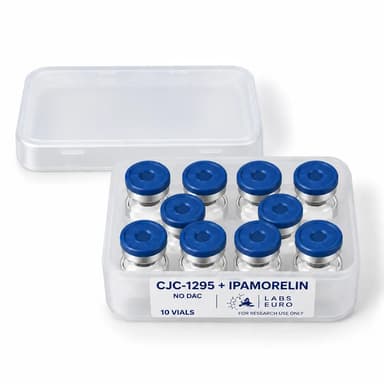
Choosing CJC-1295 (Mod GRF 1-29) for research
CJC-1295 (Mod GRF 1-29) is available with 5 mg and 10 mg of peptide per vial. Buy CJC-1295 (Mod GRF 1-29) now and choose the variant that suits your research project.