Buy CJC-1295 No DAC + Ipamorelin: two signalling pathways in focus
The product name covers two distinct peptides: CJC-1295 in the variant without DAC and Ipamorelin. Both are studied in the context of growth hormone secretion, but they address different receptor pathways. This combination of two sites of action is what makes the preparation interesting for research.
What the combination refers to
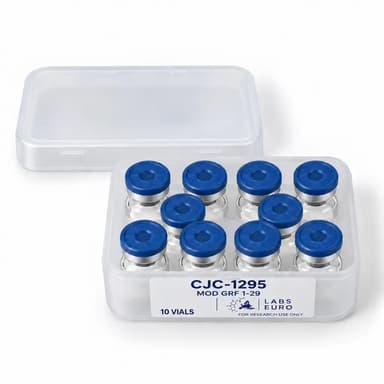
CJC-1295 belongs to the GHRH analogue family and Ipamorelin to the growth hormone secretagogues. The combination brings both components together in one variant. Exact identity matters: the CJC-1295 component described here carries no DAC, meaning no Drug Affinity Complex.
Unlike a single molecule with two functions, the preparation consists of two separate peptides. Each brings its own receptor profile. For research, this allows the contributions of the components to be considered separately and the combination to be treated as an object of study in its own right.
GHRH analogue and GHRP pathway
CJC-1295: the hypothalamic route
GHRH is produced in the hypothalamus and stimulates the release of growth hormone in the pituitary. There it binds to somatotropic cells and initiates a signalling cascade that ends with GH release. A GHRH analogue such as CJC-1295 mimics this messenger and addresses the same receptor. It therefore acts on the upstream regulation of GH secretion.
Ipamorelin: the selective GHRP pathway
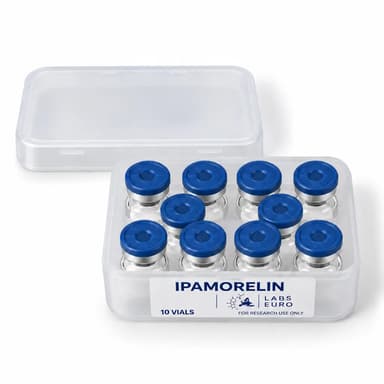
Ipamorelin has been described as a selective growth hormone secretagogue and acts via a GHRP-like receptor pathway. GHRP stands for Growth Hormone Releasing Peptide; these peptides reach the somatotropic cells through their own signalling cascade. In preclinical studies with cell cultures, rats and pigs, Ipamorelin showed targeted growth hormone release (Raun et al. on selective GH secretion).
Two different receptor routes therefore stand side by side: the GHRH pathway of CJC-1295 and the GHRP pathway of Ipamorelin. Both target the same function, the release of growth hormone from the pituitary. This constellation is the biological core of the combination and the starting point for further research questions.
Human data on the Ipamorelin component
Data from human research are available for Ipamorelin. In a pharmacokinetic-pharmacodynamic modelling study in human subjects, the peptide showed an acute growth hormone response (Gobburu et al. on the GH response in humans).
The study concerned Ipamorelin alone, not the combination with CJC-1295. It shows the GHRP pathway to be a measurable component of GH regulation in humans. It says nothing about how the two peptides interact.
Human data are not a given in peptide research. They allow statements about the acute GH response and about the relationship between peptide concentration and hormone release that cannot be derived from cell models alone.
DAC, No DAC and the combination question
DAC stands for Drug Affinity Complex. CJC-1295 exists in a form with this complex and in a form without it. The two variants differ chemically and are not interchangeable. Findings for the DAC form belong to the DAC form; no properties can be derived from them for the No-DAC variant, let alone the combination.
An FDA briefing document addresses CJC-1295-containing bulk substances and the documented combined use with Ipamorelin (FDA briefing document on the combination). The document describes reports of combination use and synergy effects claimed online. It does not provide controlled evidence for a combination effect.
For research, the combination therefore remains an exciting but open field: two well-characterised building blocks, two different signalling pathways and a combination effect that cannot be considered proven. Claims about muscle growth, regeneration or an enhanced effect cannot be derived from these data.
CJC-1295 No DAC + Ipamorelin in the shop
The combination is available as a variant with 5 mg of CJC-1295 No DAC and 5 mg of Ipamorelin per vial. Buy CJC-1295 No DAC + Ipamorelin now and view the variant in the shop.