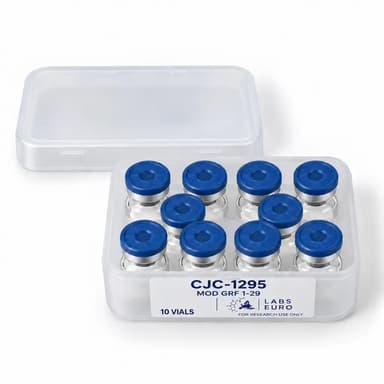
Buy CJC-1295 with DAC: a GHRH analog with long-lasting presence
Growth hormone is released in pulses. In the hypothalamus, GHRH is produced; it binds to receptors in the anterior pituitary and triggers the release of GH there. CJC-1295 with DAC acts on this signaling pathway: the molecule is a GHRH analog whose sequence mimics receptor activation and stimulates endogenous GH release. An additional chemical group extends its presence in circulation.
DAC stands for Drug Affinity Complex. The chemical extension behind it mediates albumin binding. This group is distinct from the GHRH sequence: it does not change the receptor signal itself, but rather the residence time in the blood. Albumin is the most abundant plasma protein and circulates for a long time.
When the molecule binds to albumin, it is degraded more slowly, and exposure to the GHRH receptor lasts longer. This gives the compound a profile that differs markedly from short-lived GHRH analogs.
Albumin binding as a molecular driver
The DAC group changes the kinetics, not the fundamental direction of the signal. In an early study in healthy adults, the estimated elimination half-life of CJC-1295 with DAC ranged from 5.8 to 8.1 days (study in healthy adults). This is a measurable pharmacokinetic parameter and explains why the compound is considered a long-acting GHRH analog.
The form without DAC, often called Mod GRF 1-29, is a separate variant. It consists of 29 amino acids and carries no albumin-binding group. In its assessment, the FDA describes the no-DAC form as a synthetic GHRH analog and apparently assigns the published clinical evidence to the DAC form (regulatory assessment). The extended kinetics of the DAC version therefore cannot be transferred to the no-DAC form.
What studies in healthy adults show
In two early randomized, placebo-controlled studies in healthy adults, CJC-1295 with DAC led to persistently elevated levels of circulating GH and IGF-1 (placebo-controlled studies). IGF-1 is produced primarily in the liver in response to GH and is a central growth factor for many tissues. The findings show that the compound activates the pituitary signaling cascade over the study period.
These hormone levels are surrogate markers. They demonstrate pharmacodynamic activity, but not clinical endpoints such as muscle growth, weight loss, regeneration, or anti-aging. They are also not associated with any statement about the treatment of growth hormone deficiency. The studies were early phases of clinical testing and served to characterize safety and the hormone response.
Pulsatility despite continuous stimulation
A natural question is whether persistently elevated GHRH activity flattens the natural GH pulses. A mechanistic study in healthy men investigated exactly this. Under CJC-1295 with DAC, pulsatile GH secretion was preserved while trough levels and mean GH concentrations rose (study on GH pulsatility).
The interplay between continuing discrete pulses and a higher baseline is biologically interesting. It suggests that the compound does not completely replace the pulsatile architecture of the GH axis. A preserved pulse does not mean that exposure is unchanged, however; trough levels were higher. No conclusions about physiological equivalence or a clinical advantage can be drawn from this.
CJC-1295 with DAC in a research context
The combination of GHRH receptor activity and albumin binding makes CJC-1295 with DAC a useful tool for studying the GH/IGF-1 axis over longer periods. In models, questions about receptor response, hormone kinetics, and feedback can be addressed. The clear distinction from the form without DAC helps attribute effects to the substance precisely.
Buy CJC-1295 with DAC
CJC-1295 with DAC is available as a variant containing 10 mg per vial. Anyone looking for a GHRH analog with an albumin-binding DAC group for research will find the right variant here. Buy CJC-1295 with DAC now and view the product in the shop.