Buy AHK-Cu: A Tripeptide at the Center of Follicle Research
AHK-Cu is the copper(II) complex of an unusually short peptide: three amino acids form the chain, and a copper ion is attached to it.
Three Amino Acids, One Copper Ion
The peptide portion is formed by the sequence alanine, histidine, lysine. In three-letter notation, AHK stands for Ala-His-Lys; the PubChem entry for L-alanyl-L-histidyl-L-lysine documents this identity. Histidine is more than a footnote here: through its imidazole ring, tripeptides of this kind bind copper, and in AHK-Cu the metal is present as copper(II).
Copper is an essential trace element and is bound as a cofactor in numerous enzymes. In peptide complexes, it is held through defined binding sites, which makes such molecules interesting for studying metal-peptide interactions. The short chain provides a clear model for this.
AHK-Cu and GHK-Cu: One Position Makes the Difference
The obvious comparison is with GHK-Cu, the best-known copper tripeptide. Both consist of three amino acids, both carry copper, and both share positions two and three. The difference lies at the start of the chain.
| Feature | GHK-Cu | AHK-Cu |
|---|
| Peptide sequence | Gly-His-Lys | Ala-His-Lys |
| Position 1 | Glycine | Alanine |
| Positions 2 and 3 | Histidine, lysine | Histidine, lysine |
Glycine is the smallest amino acid and has no side chain; alanine has a methyl group.
Hair Follicles in Organ Culture: Elongation and Cell Proliferation
The most direct experimental view of AHK-Cu comes from a follicle model. Human hair follicles were isolated for this purpose and kept in organ culture, meaning outside the body in a nutrient-supported tissue environment. Such follicles continue to grow in culture and can be measured. Under AHK-Cu, the elongation of isolated follicles was greater; in the same work, cultured dermal papilla cells showed a higher proliferation rate (study on AHK-Cu in human hair follicles).
The two findings are connected because they describe two levels of the same tissue: the whole, growing follicle and the cell type that drives it. That connection is exactly what makes the model so useful for research.
What Dermal Papilla Cells Do for the Follicle
The dermal papilla sits at the base of the hair follicle, embedded in a small pocket of epithelial cells. It consists of mesenchymal cells that send signals to the surrounding keratinocytes and thereby help determine whether a follicle grows, rests, or regresses. The number and activity of these cells are considered important factors in hair thickness.
That is why the proliferation rate of cultured papilla cells is a meaningful measurement: it shows whether a substance reaches the cell compartment that coordinates the follicle cycle. The model remains a model, however. It describes cell behavior in the culture dish, not hair regrowth on the head.
Apoptosis Markers: Bcl-2, Bax, Caspase-3 and PARP
A second focus of the same study was on proteins that accompany programmed cell death. Bcl-2 inhibits apoptotic signaling pathways, Bax promotes them; their ratio is considered a measure of a cell's tendency to survive. Under AHK-Cu, this ratio was shifted toward Bcl-2. In addition, fewer cleavage products of caspase-3 and PARP were found. Such cleavage products form when a cell enters apoptosis and are considered established markers of this process.
One detail matters for accuracy: the number of counted apoptotic cells did not decrease significantly in the experiment. The protein markers therefore responded more clearly than the cellular endpoint. All findings come from isolated human tissue and cultured cells; no controlled study in humans is available for this.
Choosing AHK-Cu for Research
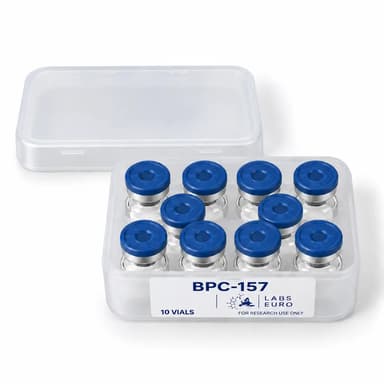
AHK-Cu is offered at 50 mg or 100 mg per vial. If you are looking for a copper tripeptide for cell and tissue models, you can choose between the two amounts here and select the variant that matches your experimental setup. Buy AHK-Cu now and view the matching variant in the shop.