Buy Melanotan I: Afamelanotide and the Biology of Pigmentation
Skin is not a passive coat. It reads light, processes signals and has its own messenger system made of peptide hormones. Right in the middle of this system sits Melanotan I, known internationally as afamelanotide and chemically as NDP-MSH: a synthetic analog of alpha-melanocyte-stimulating hormone (alpha-MSH) made of 13 amino acids.
Its biological target is remarkably clear. Afamelanotide binds predominantly to the melanocortin-1 receptor (MC1R) on melanocytes and stimulates the formation of eumelanin there, the brown-black skin pigment (European product information on afamelanotide). This makes it possible to follow a single receptor pathway from signal to visible pigment.
Three Names, One Molecule
Melanotan I, NDP-MSH and afamelanotide refer to the same active substance. The names come from different contexts: Melanotan I from peptide research, NDP-MSH from peptide nomenclature, afamelanotide from drug development. That helps with classification, because many misunderstandings arise purely from the variety of names.
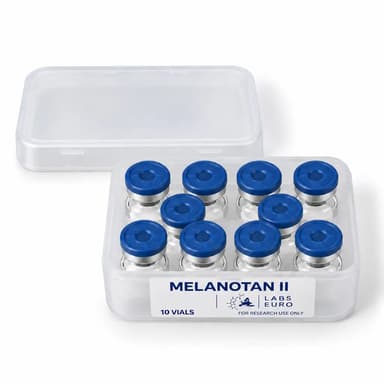
Melanotan II is a separate matter. It is an independent, ring-shaped analog with a different receptor profile and not a variant of Melanotan I. Anyone who reads the two names side by side should treat them as two different molecules.
MC1R, cAMP and Eumelanin: The Pathway to Pigment
The MC1R belongs to the G-protein-coupled receptors. When it is activated, the concentration of cAMP in the melanocyte rises. This switches on the transcription factor MITF, which drives the pigment genes, including tyrosinase as the central enzyme of melanin synthesis.
What matters is which melanin is formed. Strong MC1R activation favors eumelanin, which is packaged into melanosomes and passed to surrounding keratinocytes. There it settles over the cell nucleus like an absorbing layer and distributes pigment across the epidermis.
| Property | Eumelanin | Pheomelanin |
|---|
| Hue | brown to black | yellow to reddish |
| Formation | favored by strong MC1R activation | favored by weak MC1R activation |
| Light behavior | broadly absorbing, photostable | less photostable under UV |
Erythropoietic Protoporphyria: The Clinical Context
A rare metabolic disease shows that this pigment pathway can be medically relevant. In erythropoietic protoporphyria (EPP), the last enzyme of heme biosynthesis, ferrochelatase, has reduced activity. As a result, protoporphyrin IX accumulates, including in erythrocytes, plasma and skin.
Protoporphyrin IX is sensitive to light. Even brief exposure to visible light can trigger phototoxic reactions that manifest as burning pain, often within minutes. Visible skin changes are not necessarily present, which makes the disease hard to grasp in everyday life.
This is precisely where afamelanotide was studied clinically, in a specific formulation: an implant that releases the active substance continuously. The European authorization covers the prevention of phototoxic reactions in adults with EPP; the US approval covers extended pain-free light exposure in adults with EPP-associated phototoxic reactions (US approval documents for Scenesse). This classification applies to the tested implant.
Randomized Data: Cumulative Light Time Instead of Daily Values
Two randomized, placebo-controlled trials studied the formulation in adults with EPP, one in Europe with 74 and one in the United States with 94 participants. The measure recorded was cumulative pain-free time in direct sunlight over the entire observation period, not a value per day (randomized afamelanotide trials in EPP).
In the US trial, the median over six months was 69.4 hours with afamelanotide versus 40.8 hours with placebo. In the European trial, the median over nine months was 6.0 versus 0.8 hours. The protocols differ, so the figures are not directly comparable with one another.
In addition to light time, disease-specific quality of life improved in the trials. The findings apply to adults with EPP, to the implant studied and to the respective observation conditions; they cannot be transferred to healthy skin or other photodermatoses. These data are not linked to a cosmetic tanning indication.
Melanotan I 10 mg for Pigment Research
What makes Melanotan I interesting for research is the clarity of the model: a peptide of 13 amino acids, one predominantly engaged receptor, a well-described pathway through to pigment. Anyone investigating pigment biology, MC1R signaling pathways or the role of eumelanin finds a manageable and well-documented starting point here.
Melanotan I 10 mg contains an active substance amount of 10 mg per vial; the MT-1 10 mg variant can be selected directly in the shop. The figure refers to the mass of the contents, not a concentration and not an amount for use. Buy Melanotan I 10 mg now and view the variant in the shop.