Epithalon, usually called Epitalon in the specialist literature, is a synthetic tetrapeptide made up of four amino acids: alanine, glutamic acid, aspartic acid and glycine. The short notation AEDG summarizes this sequence. The molecule has attracted attention in cell and aging research for years because it addresses a readily measurable process: the question of how cells maintain their telomeres and what role the enzyme telomerase plays in this process.
A chemically well-defined tetrapeptide
The identity of Epithalon is unambiguous: it consists of four amino acids in a fixed order and is synthetically produced and chemically precisely defined. Epithalon is distinct from Epithalamin, a historical extract from the pineal gland that was studied in earlier work. When people speak of Epitalon today, they generally mean the defined AEDG tetrapeptide, not the extract. This distinction matters because findings from extracts cannot be readily transferred to a single peptide.
Telomeres, hTERT and telomerase: three separate measures
Telomeres are repetitive DNA sequences at the ends of chromosomes. They protect the genetic information from degradation and become a little shorter with each cell division. Telomerase is an enzyme complex that can lengthen these sequences again; its catalytic subunit is called hTERT. For research, it is crucial to consider three things separately: hTERT expression, the enzyme activity that can actually be measured and the resulting telomere length. Only their interplay provides a picture of whether a cell is changing its telomere homeostasis.
Early observations in human fibroblasts
In a study of human fetal fibroblasts that naturally lack active telomerase, Epithalon induced the expression of the catalytic subunit, increased the enzyme activity and led to telomere lengthening (PubMed entry for the fibroblast study). What makes this observation interesting is the model: cells that normally do not use this mechanism responded to the tetrapeptide. The data come from cell cultures and do not demonstrate an effect on the human lifespan.
The cell type determines the pathway
A comparative study of human cell lines showed that Epitalon lengthened telomeres in normal fibroblasts and epithelial cells through activation of hTERT and telomerase. Two breast cancer cell lines responded differently: in these cells, telomeres lengthened via the alternative lengthening of telomeres (ALT) pathway, without a significant increase in telomerase activity (comparative study in cell lines). The finding describes two different cellular strategies and makes clear how strongly the cell type determines the response.
| Cell model | Telomere pathway | Observation |
|---|
| Normal fibroblasts (IBR.3) | Telomerase | hTERT activation and telomere lengthening |
| Normal epithelial cells (HMEC) | Telomerase | Telomere lengthening |
| Breast cancer cells (21NT, BT474) | ALT | Telomere lengthening without a significant increase in telomerase |
For research, this comparison is interesting because it shows that telomere lengthening does not automatically run through the same machinery. This does not prove a therapeutic effect against cancer, and the data do not support such an assumption.
Aging research in an animal model
In an experiment with female CBA mice, administration of the peptide extended the lifespan and was accompanied by changes in age-associated cycle function and oxidative processes. Body weight, physical activity and behavioral parameters, by contrast, did not improve (lifespan experiment in mice). The result is strain-specific and protocol-dependent; an extension of the human lifespan has not been demonstrated. Precisely this clear separation between model and transferability makes the work a useful point of connection for aging research.
Buy Epithalon: variants for research
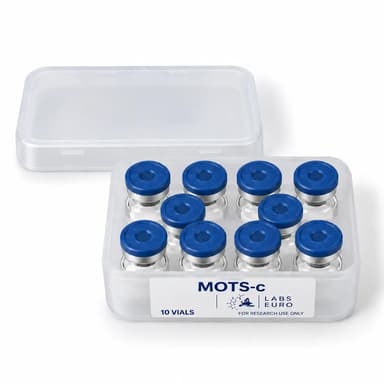
Epithalon is available as Epitalon with 10 mg and as Epithalon with 50 mg per vial. The figure describes the amount or strength of the peptide per vial, not a concentration and not an administered dose. Buy Epithalon now and choose the right variant for your research project in the shop.