Specification
| Molecule | Klow Stack (peptide blend) |
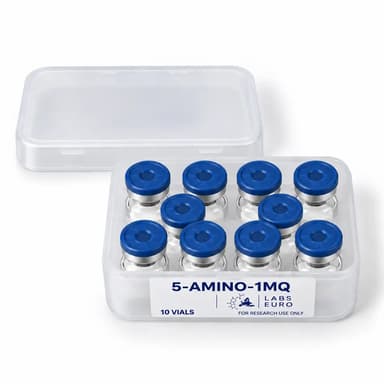
| Composition per vial | GHK-Cu 25 mg + TB-500 10 mg + BPC-157 10 mg + KPV 10 mg |
| Form | Lyophilized powder, single vial |
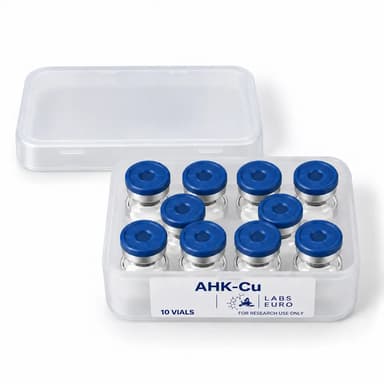
| Box contents | 10 vials of identical composition |
| Purity per component | ≥99 % (HPLC) |
Mechanism of action
Klow Stack combines GHK-Cu, TB-500, BPC-157 and KPV in a single vial. GHK-Cu is associated with collagen formation and the extracellular matrix, TB-500 with cell migration and the cytoskeleton, BPC-157 with repair and angiogenesis models, and KPV with inflammation-modulating signaling pathways in cell culture models. The blend allows all four peptides to be studied in one in-vitro setup, so their contributions can be observed under comparable conditions. This makes it possible to examine interactions in the model without preparing the peptides separately. Researchers who buy Klow Stack use this 10-vial kit as a defined reference for in-vitro work.
Reconstitution and handling
Reconstitution takes place in the laboratory with a suitable sterile solvent. The resulting solution is processed promptly and protected from direct light during handling. Work is carried out in a clean area using standard laboratory technique. Specific volume, concentration or setup guidance is outside the scope of this description; the laboratory selects the parameters that suit its in-vitro model.
In-vitro research
Klow Stack is used in in-vitro research across models of extracellular matrix and collagen, cell migration, tissue repair and inflammatory biology cell models. The four components complement each other in these settings: GHK-Cu contributes matrix and collagen context, TB-500 migration and cytoskeleton models, BPC-157 repair and angiogenesis models, and KPV inflammation-related signaling. This creates comparable conditions under which the blend can be examined in cell culture. Use remains confined to the laboratory and the in-vitro models described here.
Quality and analytics
Each of the four components, GHK-Cu, TB-500, BPC-157 and KPV, is tested individually for purity by HPLC and meets ≥99 %. Every component additionally undergoes an identity check. The reported values refer to the individual lots from which the blend is prepared. Purity is therefore documented separately for all four components, not only as a single figure for the finished vial.